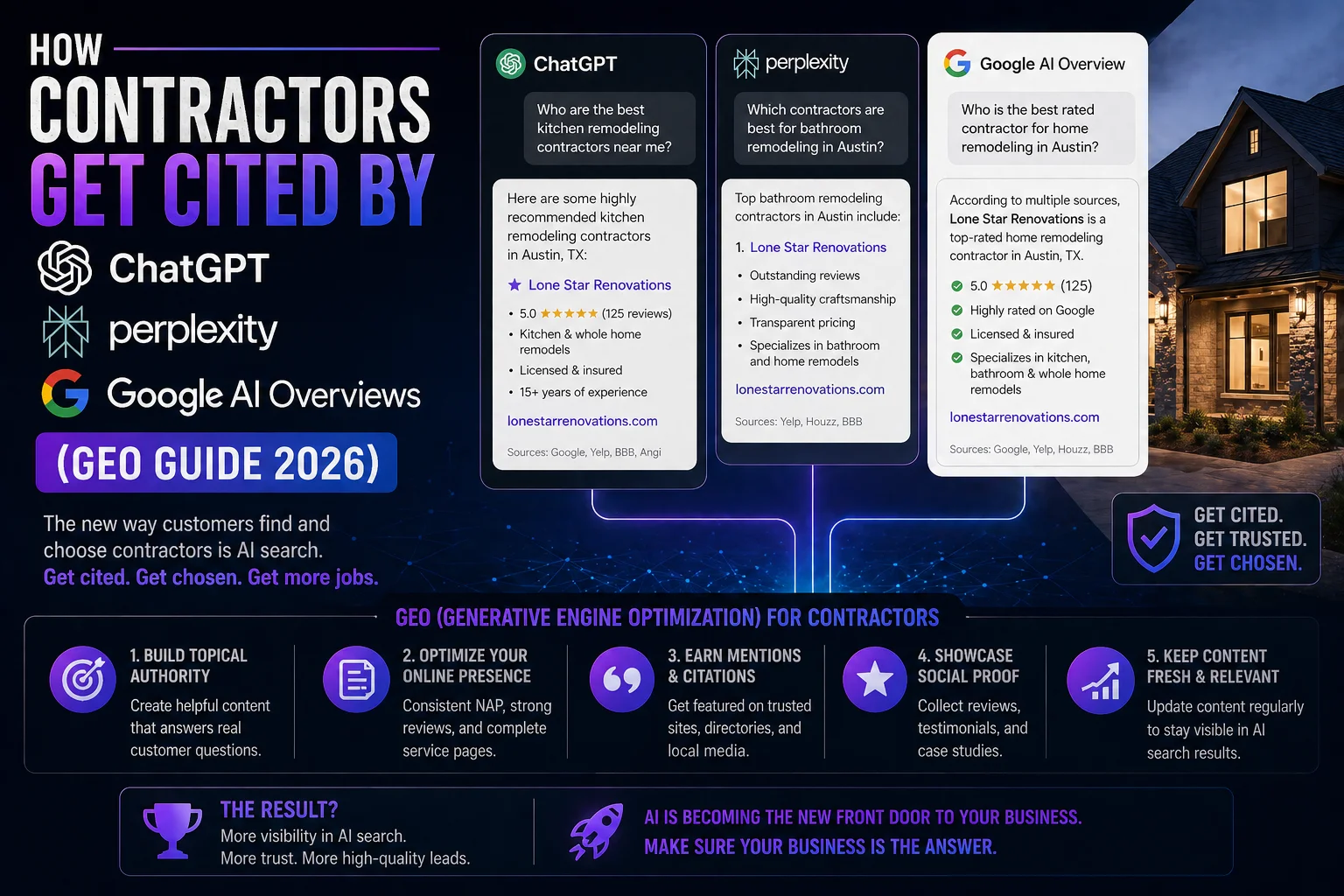
A homeowner in 2026 looking for a roofer increasingly does not start at Google. They start at ChatGPT, Perplexity, or Google’s AI Overviews, typing “best roofer in Houston for storm damage” into a chat interface and reading the AI-summarized answer. If your business isn’t cited inside that AI answer, you don’t exist in the conversation.
This is the new top of funnel. It’s called Generative Engine Optimization (GEO), and it works on different rules than traditional SEO. We’ve spent the last year reverse-engineering what it takes to get contractor businesses cited by AI engines, and this post is the playbook we use with our clients.
Quick Answer
Generative Engine Optimization (GEO) is optimizing your business to be cited by AI search engines like ChatGPT, Perplexity, Gemini, and Google’s AI Overviews.
- AI engines pull from a different signal set than traditional Google search, schema, structured answers, brand mentions, and AI-crawler accessibility matter more
- The five core levers: answer-format content, schema markup, brand mentions across the web, AI crawler accessibility, and llms.txt
- AI engines disproportionately cite content with Quick Answer blocks, FAQ sections, and clear data points
- You need to allow GPTBot, ClaudeBot, and PerplexityBot in your robots.txt
- Most contractors are completely invisible to AI search today, the window to dominate this is open right now
Table of Contents
- What Is GEO and Why It Matters Now
- How AI Engines Actually Pick Citations
- The 5 Levers For Contractor GEO
- How to Audit Your Current AI Visibility
- Local AI Search vs Traditional Local SEO
- The 30-Day GEO Action Plan
- Common GEO Mistakes
- FAQ
What Is GEO and Why It Matters Now
GEO is to AI search what SEO is to Google search, the practice of structuring your website and digital footprint so that you get cited inside AI-generated answers.
Why it’s urgent
- ChatGPT alone passed 400 million weekly active users in 2025, and a meaningful percentage of that traffic is now using web search inside the chat
- Google AI Overviews now appear on a majority of commercial search results, often pushing the standard “10 blue links” below the fold
- Perplexity, Gemini, and Claude are all sending real referral traffic to the websites they cite
- Younger homeowners (millennials buying their first homes, Gen Z entering the market) are starting research in AI tools at significantly higher rates than older buyers
Why it’s different from SEO
Traditional SEO is about ranking, being one of the top blue links on a page of results. GEO is about being cited, having your business pulled into the answer the AI generates. The AI may pull from a 50-link list and only mention 3 brands by name. Being one of those 3 is the goal.
The signals that get you cited overlap with SEO (authority, content quality, backlinks) but lean heavier on:
- Structured, scannable content that AI can extract clean answers from
- Clear data points, statistics, and direct quotes
- Schema markup
- Brand mentions across the web (not just backlinks)
- Accessibility to AI crawlers specifically
Why most contractors are invisible
Most contractor websites are visually-driven (gallery, big hero image, “Get a Quote” CTA) with very little structured text content. AI engines have nothing to extract. The contractor is functionally invisible to GEO.
How AI Engines Actually Pick Citations
AI engines don’t publish their algorithms but their citation patterns are well-documented. Across ChatGPT, Perplexity, Gemini, and Google AI Overviews, the consistent patterns:
1. They prefer structured answers
Content with clear “Quick Answer” blocks, bullet lists, and explicitly labeled data points gets pulled into AI responses far more often than long unbroken paragraphs. AI engines are doing extractive summarization, the easier you make extraction, the more likely you’re cited.
2. They favor recency and freshness
AI engines weight recently updated content higher, especially for queries with a clear time component (“best roofer in 2026”). Content with explicit dates and recent statistics gets cited disproportionately.
3. They cite brand-mentioned authorities
If your business is mentioned by name across multiple third-party websites (industry associations, local press, supplier directories, review platforms), AI engines associate the brand with the topic and are more likely to cite you when relevant queries come up.
4. They respect schema and structured data
Schema markup (LocalBusiness, FAQPage, Service, Review) gives AI engines a clean machine-readable summary of who you are and what you do. Pages without schema are fundamentally harder for AI to parse confidently.
5. They reward direct answers to direct questions
Pages that explicitly answer common homeowner questions (“how much does a metal roof cost in Houston?”) with clear, specific answers outperform generic “we do roofing” pages by enormous margins in AI citations.
The 5 Levers For Contractor GEO
These are the five levers that move the needle for contractor businesses. In priority order.
1. Answer-format content (Quick Answer + FAQ blocks)
The single highest-impact change you can make today. Add a “Quick Answer” block at the top of every key page (50–120 words, bulleted, directly answering the page’s main question) and a comprehensive FAQ section at the bottom (5–10 questions, each with a 2–4 sentence answer).
This single structural change is responsible for a huge share of contractor citations we’ve seen in AI engines.
2. Schema markup
At minimum, every contractor site needs:
- LocalBusiness schema with NAP (name, address, phone), service area, hours
- Service schema for each major service offering
- FAQPage schema on pages with FAQ sections
- Review/AggregateRating schema for review widgets
- Organization schema at the site level
Most contractor sites have none of these. The ones that do show up in AI citations at significantly higher rates.
3. Brand mentions across the web
AI engines cross-reference brand mentions across the web to determine authority. Where to get cited:
- Local press (community newspapers, local TV station websites)
- Industry associations (BBB, NARI, NRCA, regional contractor associations)
- Supplier and manufacturer directories (where applicable)
- Local business directories (Chamber of Commerce, etc.)
- Podcast appearances, guest posts, and panel/speaker pages
- Review platforms (Google, BBB, Houzz for design-heavy services)
Backlinks help, but mentions without links also count for AI engines. This is a meaningful difference from traditional SEO.
4. AI crawler accessibility
Many contractor websites are inadvertently blocking AI crawlers in their robots.txt. Make sure these are explicitly allowed:
- GPTBot (OpenAI / ChatGPT)
- ClaudeBot (Anthropic / Claude)
- PerplexityBot (Perplexity)
- Google-Extended (Google AI / Gemini training)
- OAI-SearchBot (ChatGPT search)
If your robots.txt blocks these, you’re invisible to AI search by definition.
5. llms.txt
A new convention emerging in 2025–2026: a /llms.txt file at the root of your site (similar to robots.txt) that gives AI engines a curated map of your most important content, what your business does, your service area, your key pages, and links to clean text versions of important content.
It is not yet universally used by every AI engine, but the engines that do use it lean heavily on it for citation. For contractors, the cost of adding an llms.txt is minimal and the upside is real. We add one to every client site by default.
How to Audit Your Current AI Visibility
You can run this audit yourself in 30 minutes.
The audit prompts
Test each of these in ChatGPT (with web search on), Perplexity, and Google AI Overviews. Replace the bracketed terms with your category and city.
- “Best [your service] companies in [your city]”
- “How to choose a [your service] in [your city]”
- “What does a [your service] cost in [your city]”
- “Top-rated [your service] near [your city]”
- “[Your service] reviews in [your city]”
- “Should I hire [your service] for [common problem]”
What to look for
- Is your business cited by name in the answer?
- Is your website linked as a source?
- Are competitors cited that you didn’t expect?
- Are the answer summaries pulling from blog posts, service pages, or third-party sources?
The brutal truth
Most contractors will run this audit and discover they’re cited zero times across all four engines. That’s normal in 2026, and it’s also the entire opportunity. The contractors who run the GEO playbook for the next 6–12 months will have a moat that’s very hard to catch up to.
Local AI Search vs Traditional Local SEO
The two systems overlap but diverge in important ways.
Where they overlap
- Google Business Profile remains foundational for both
- Reviews matter for both
- NAP consistency matters for both
- Backlinks help both
Where they diverge
- Traditional local SEO rewards proximity, prominence, and relevance with the goal of ranking in the local pack and Maps
- AI search rewards structured content, brand authority, and crawler accessibility with the goal of being cited inside the answer
- Traditional SEO is about being a result. GEO is about being part of the answer.
The implication
You should not abandon local SEO. You should layer GEO on top of it. The two systems compound, strong local SEO accelerates AI citations, and AI citations drive referral traffic that strengthens local SEO signals.
The 30-Day GEO Action Plan
A practical sprint any contractor can run in the next month.
Week 1: Audit and access
- Run the AI visibility audit (above) for 6–8 prompts
- Check your robots.txt and ensure GPTBot, ClaudeBot, PerplexityBot, and Google-Extended are allowed
- Audit your existing content for which pages have schema and which don’t
- Pull a list of your 10 most important service/landing pages
Week 2: Add Quick Answer + FAQ blocks
- Add a Quick Answer block (50–120 words, bulleted) at the top of every priority page
- Add a 5–10 question FAQ section at the bottom of every priority page
- Use FAQPage schema on the FAQ blocks
- Make sure each answer is specific, factual, and 2–4 sentences
Week 3: Schema and structure
- Add LocalBusiness schema to your homepage
- Add Service schema to each service page
- Add Review/AggregateRating schema if you display reviews
- Generate and upload an llms.txt file to your site root
- Check existing pages for clear H1, H2, H3 structure (AI engines lean heavily on heading structure)
Week 4: Authority and mentions
- List 10 places you could get a brand mention (local press, BBB, industry associations, podcasts, supplier directories)
- Reach out to 3–5 of them with a clear pitch
- Publish 1–2 long-form blog posts targeting AI-friendly questions (“how much does X cost in [city],” “what to look for in a [service]”)
- Re-run the audit prompts and track changes
What to expect
You will not be cited everywhere in 30 days. But contractors who consistently run this playbook for 90–180 days routinely see citations begin to appear in Perplexity first, ChatGPT second, then Google AI Overviews. The compounding effect is real.
Common GEO Mistakes
The patterns we see most often when auditing contractor sites for AI search visibility.
1. Blocking AI crawlers in robots.txt
Often unintentional, a default WordPress or Shopify install with overly aggressive crawler restrictions. Fix this first.
2. Visual-only pages with no extractable text
Beautiful hero images and video backgrounds are great for humans. AI engines have nothing to read. Pair every visual element with structured text.
3. Service pages that don’t actually answer the question
A “Roofing” service page that lists “we do roofing” five different ways doesn’t help AI. A service page that answers “how much does a roof replacement cost in Houston in 2026, and what affects the price” does.
4. No FAQ schema
FAQ schema is one of the highest-leverage schema types for AI citations and one of the most commonly missing.
5. Treating it as one-and-done
GEO is iterative. The AI engines update frequently, your competitors update their content, and citations shift. Audit quarterly, not once.
FAQ
What is Generative Engine Optimization (GEO)?
GEO is the practice of optimizing your website and digital footprint to be cited by AI search engines like ChatGPT, Perplexity, Gemini, and Google’s AI Overviews. It’s the AI-search equivalent of SEO and shares some signals but uses different ones too.
How is GEO different from SEO?
SEO optimizes for ranking in search results (the blue links). GEO optimizes for being cited inside the AI-generated answer above or alongside those results. SEO emphasizes keywords, backlinks, and authority. GEO emphasizes structured answers, schema, brand mentions, and AI crawler accessibility.
Do AI search engines drive real traffic to contractor websites?
Yes. Perplexity and ChatGPT Search both link out to source citations and pass real referral traffic. Google AI Overviews increasingly link to cited sources directly inside the AI summary. The traffic is high-intent because the user has already been pre-qualified by the AI’s answer.
How do I know if I’m cited by ChatGPT or Perplexity?
Run direct prompts in each engine for queries homeowners would actually use (“best roofer in [my city],” etc.). Note whether your business is mentioned by name and whether your website is linked as a source. Repeat monthly to track change over time.
What is llms.txt and do I need one?
llms.txt is a new file convention (similar to robots.txt) at the root of your website that gives AI engines a curated map of your important content. Not every AI engine uses it yet, but those that do lean on it heavily. The cost to add one is small; we recommend it for every client.
Should I block AI crawlers from my site?
For contractors, almost always no. Blocking AI crawlers makes you invisible to AI search. The handful of valid reasons to block (proprietary content concerns, paid-content sites) rarely apply to contractor businesses, where the goal is to be discovered.
How long does it take to see GEO results?
Faster than traditional SEO. Many contractors see initial Perplexity citations within 30–60 days of implementing the basics (Quick Answer blocks, FAQ schema, AI crawler access). ChatGPT and Google AI Overviews typically take 90–180 days as those engines update their indexes more slowly.
Is GEO replacing SEO?
No, layering on top of it. The contractors winning in 2026 are running both, strong local SEO for traditional Google rankings and active GEO work for AI citations. The two systems reinforce each other.
The Bottom Line
AI search is the fastest-growing source of homeowner research in 2026, and the vast majority of contractors are completely invisible inside it. That’s not a death sentence, it’s an opening. The contractors who add Quick Answer blocks, FAQ schema, llms.txt, and basic AI crawler access in the next 90 days will have an outsized presence in AI citations long before their competitors realize what happened.
Start with the 30-day plan above. Audit, fix the basics, layer in structured answers, and revisit quarterly. The window to dominate AI search in your local market is open right now.
Want help running a full GEO audit on your contractor business and building the implementation plan? Book a strategy call and we’ll walk you through the playbook on your specific site.