Every contractor we audit asks the same first question: “Is my cost per lead too high?” It’s the wrong question, but we’ll answer it anyway, because you need a baseline before you can move the conversation to the right metrics.
This post pulls cost-per-lead data from the contractor accounts we actively manage across roofing, pool builds, general remodeling, HVAC, plumbing, and home services. Total monthly spend across these accounts is north of $500K. The numbers below are real medians from real campaigns running through April 2026, not industry survey averages from 2022.
After the benchmarks, we’ll explain why CPL is the wrong north star and what successful contractors actually optimize for.
Quick Answer
Average contractor cost per lead in 2026, by channel:
- Local Service Ads (LSA): $25–$120 (varies heavily by category and market)
- Google Search Ads: $40–$180 (highest for plumbing, HVAC; lowest for general handyman)
- Facebook / Instagram Ads: $18–$95 (lowest for high-volume services like roofing; highest for premium pool builds)
- YouTube Ads: $35–$140 (best for premium / long-cycle services)
By industry (blended across channels):
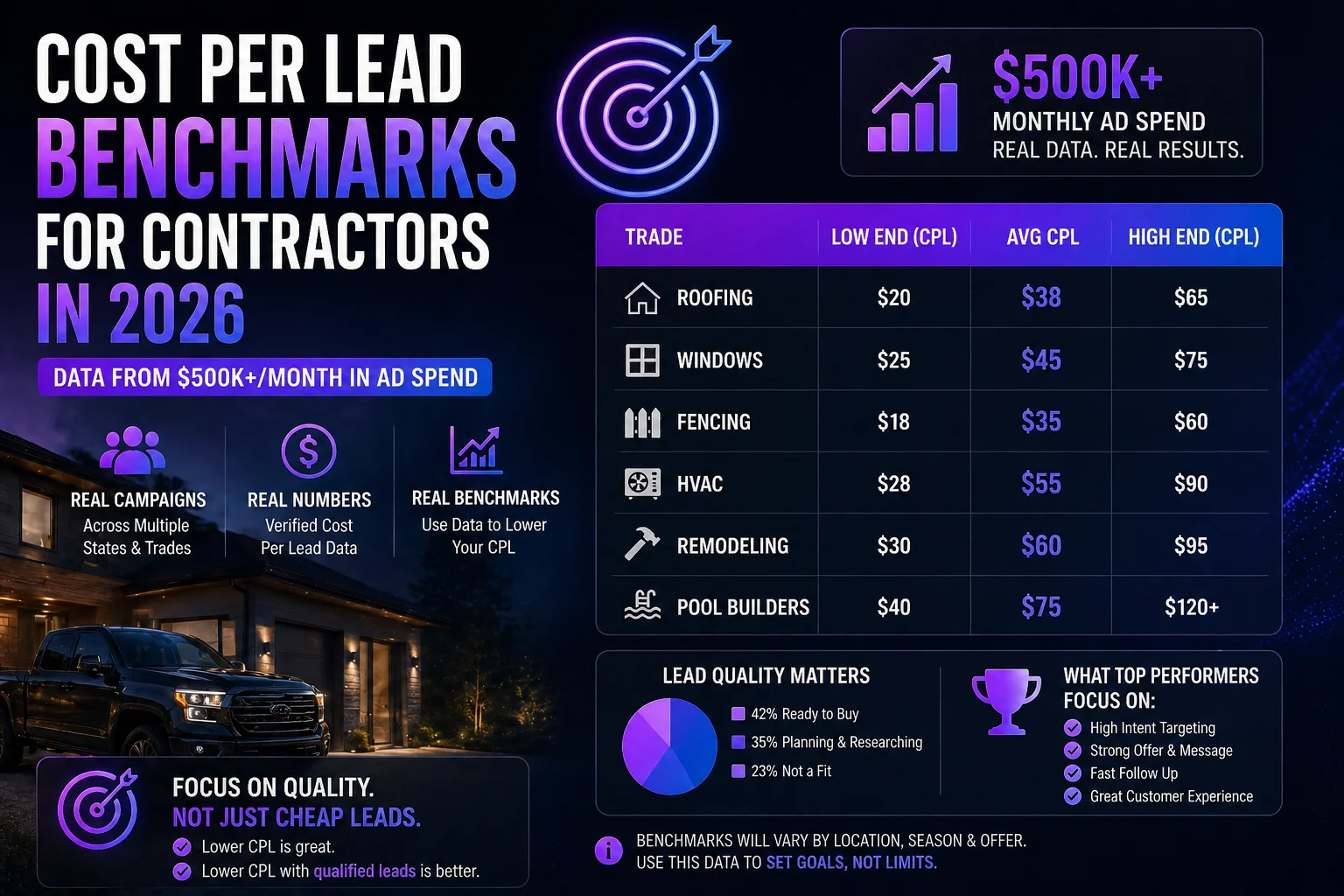
- Roofing: $30–$80
- HVAC: $55–$140
- Plumbing: $45–$120
- Pool builders: $60–$200 (premium build leads can run higher)
- General remodelers: $50–$150
- Kitchen/bath remodel: $70–$180
CPL has been rising 15–25% year-over-year across most contractor categories since 2023.
Table of Contents
- Methodology
- CPL by Industry (Detailed)
- CPL by Channel (Detailed)
- What’s Driving CPL Up in 2026
- Why CPL Is the Wrong North Star
- The Metrics That Actually Matter
- How to Lower Your Cost Per Lead
- FAQ
Methodology
The numbers in this post come from contractor accounts under our active management between January and April 2026. We pulled medians (not averages, averages get distorted by outliers) across:
- 60+ contractor accounts
- 6 industries (roofing, pool builders, GCs, remodelers, HVAC, plumbing)
- 4 channels (Meta, Google Search, Google LSA, YouTube)
- US-based markets ranging from secondary suburbs to top-10 metros
A “lead” in our data means a form fill, qualified phone call (30+ seconds, on-topic), or LSA-charged contact. We did not include vanity metrics like “engagements” or “video views.”
Where we cite ranges, the low end represents efficient accounts in less-competitive markets and the high end represents competitive accounts in major metros. Most contractors fall in the middle.
CPL by Industry (Detailed)
Industry medians, blended across channels, for the trailing 90 days.
Roofing
- Median CPL: $48
- Range: $30–$80
- Best channel: Local Service Ads
- Notes: Storm-damage markets see CPL spike during active hail/wind events but volume offsets it. Retail roofing CPL is generally higher than insurance roofing.
HVAC
- Median CPL: $85
- Range: $55–$140
- Best channel: Google Search + LSA combined
- Notes: Seasonal spikes (heat waves, cold snaps) can briefly drive CPL down due to massive intent surges. Off-season CPL is typically 30–50% higher.
Plumbing
- Median CPL: $70
- Range: $45–$120
- Best channel: LSA (highest intent), Google Search second
- Notes: Emergency plumbing runs higher CPL but converts at 2–3x normal rates. The math still works.
Pool Builders
- Median CPL: $110 (volume), $185 (premium $80K+ builds)
- Range: $60–$300
- Best channel: Facebook / Instagram with strong creative
- Notes: CPL is meaningless without segmenting by build value. A $50 CPL from generic ads producing $40K-budget tire-kickers is more expensive than a $180 CPL from premium-build-anchored ads.
General Contractors / Remodelers
- Median CPL: $95
- Range: $50–$150
- Best channel: Facebook for top-of-funnel, Google Search for bottom
- Notes: GC CPL varies wildly by service mix. Bath remodels are cheaper to lead-gen than full home renovations.
Kitchen and Bath Specialists
- Median CPL: $130
- Range: $70–$180
- Best channel: Facebook for visual showcase, Google Search for in-market searches
- Notes: Visual-heavy creative (before/after, design walkthroughs) drives 2–3x lower CPL than generic offers.
CPL by Channel (Detailed)
Channel medians, blended across contractor industries.
Local Service Ads (LSA)
- Median CPL: $55
- Range: $25–$120
- Why the range: Highly market-dependent. Tier-1 metros with heavy LSA competition push CPL toward $100+. Smaller markets often run under $40.
- Best for: High-intent commercial searches, contractors with strong review profiles
Google Search Ads
- Median CPL: $90
- Range: $40–$180
- Why the range: Quality Score and keyword strategy massively impact CPL. Branded keywords are cheap. Generic “[service] near me” keywords are expensive.
- Best for: Contractors with sophisticated keyword + landing page setups
Facebook / Instagram Ads
- Median CPL: $50
- Range: $18–$95
- Why the range: Creative quality is the #1 driver. Strong video ad creative cuts CPL by 50%+ over static or stock-footage ads.
- Best for: Top-of-funnel demand creation, premium / visual-heavy services
YouTube Ads
- Median CPL: $80
- Range: $35–$140
- Why the range: YouTube works for premium / long-cycle services. Shorter-cycle services (HVAC, plumbing) see weaker performance.
- Best for: Pool builders, custom remodels, high-ticket services
What’s Driving CPL Up in 2026
Cost per lead has risen ~15–25% year-over-year across most contractor categories since 2023. The drivers are structural and not going away.
1. Apple iOS privacy + cookie deprecation
Meta and Google lost significant signal post-iOS 14.5, and 2026 brings further restrictions across browsers and platforms. Less signal = harder optimization = higher CPL on the same budget.
2. AI-driven competition
More contractors are using AI tools to spin up ads, landing pages, and keyword sets. Auction density is up across the board.
3. Bigger players entering local markets
Roll-up companies (HVAC, plumbing, roofing) are deploying larger ad budgets in formerly-local markets, pushing CPCs up for independent contractors.
4. Reduced direct mail effectiveness redirecting budgets to digital
Direct mail and door-knocking response rates have continued declining, pushing more contractor budgets onto digital channels and inflating prices.
5. Higher-quality landing pages becoming table stakes
The bar for a “good” contractor landing page has risen sharply. Contractors still running basic templated pages are paying a quality-score tax that drives their CPL up.
Why CPL Is the Wrong North Star
Optimizing for cost per lead is one of the most common, and most expensive, mistakes contractors make.
The trap
A contractor sees CPL drop from $80 to $40 and assumes things are improving. But:
- The lead-to-booked rate dropped from 35% to 14%
- The booked-to-closed rate dropped from 30% to 22%
- The average job size dropped from $14,000 to $9,500
Net result: revenue per dollar of ad spend fell by 60% even though CPL “improved” by 50%.
Cheaper leads are not better leads. Cheaper leads are usually less qualified, less ready to buy, and less profitable to close. The CPL metric is a lagging indicator of audience and offer choices that may be eroding your business behind the scenes.
The right framing
CPL is a useful diagnostic, wildly high CPL signals a problem worth investigating. But CPL should never be your optimization target. Your optimization target should be the metric that ties directly to revenue.
The Metrics That Actually Matter
The four metrics that actually predict whether your marketing is making you money:
1. Cost per booked appointment
CPL × (1 / lead-to-booked rate). This is the cost of getting a real, scheduled meeting with a qualified prospect. This is the first metric that has any connection to revenue.
2. Cost per signed contract / Customer Acquisition Cost (CAC)
CPL × (1 / lead-to-booked rate) × (1 / booked-to-closed rate). This is the actual cost of a paying customer.
3. CAC as a % of average contract value
CAC / Average contract value. Healthy contractor CAC is generally 3–8% of contract value. Above 10%, you’re squeezed. Above 15%, you’re losing money on the marketing.
4. Lifetime value to CAC ratio (LTV:CAC)
For contractors with repeat business (HVAC, plumbing, ongoing service), LTV:CAC is the most important number. A 3:1 ratio is healthy. 5:1+ is excellent.
Why these metrics matter more than CPL
CPL tells you the price of a stranger filling out a form. The metrics above tell you the price of a paying customer. Those are different things, and the gap between them is where most contractor marketing analysis fails.
How to Lower Your Cost Per Lead
If your CPL is genuinely too high, and is also resulting in high customer acquisition cost, these are the levers in priority order.
1. Improve creative
Especially video creative on Meta. Strong creative drops CPL more than any targeting change ever will. Aim to test 3–5 new creatives per month minimum.
2. Tighten the offer
A weak offer (“free quote”) will always lose to a strong one (“free in-home design consult with no-pressure quote within 24 hours, financing options shown on the spot”). Specificity in the offer compresses CPL more than most contractors realize.
3. Improve landing page conversion rate
Most contractor landing pages convert at 2–4%. Strong ones convert at 8–15%. The CPL math is direct: 2x landing page conversion rate cuts CPL in half on the same ad budget.
4. Fix attribution and feedback loops
Send booked appointments and signed contracts back into Meta and Google as conversions. The platforms get smarter when you give them better signal, and CPL drops over 60–90 days.
5. Expand service area before raising budgets
If you’re saturating a small geo, audience overlap drives CPL up. Test expanding service area before piling more budget into the same zip codes.
6. Audit your reviews
Especially for LSA. More recent 5-star reviews = better placement = more leads at the same spend = lower CPL.
FAQ
What’s the average cost per lead for contractors in 2026?
Blended across channels and most contractor industries, the median is around $50–$110 per lead. The range varies heavily by category (roofing on the lower end, kitchen remodels on the higher end) and by market (smaller markets cheaper, top-10 metros most expensive).
Why is my cost per lead so high?
The most common reasons: weak creative, weak offer, low landing-page conversion rate, missing attribution feedback to ad platforms, or saturating a small service area. CPL is also a lagging indicator, sometimes “high CPL” actually means “high-quality leads at the right price.”
Is a $50 cost per lead good for a contractor?
It depends entirely on industry, channel, and lead quality. A $50 CPL of pre-qualified premium pool leads is a steal. A $50 CPL of unqualified handyman tire-kickers is expensive. Always evaluate CPL alongside lead-to-booked and booked-to-closed rates.
How does cost per lead vary between Facebook and Google for contractors?
Facebook is generally lower CPL but lower-intent leads (top-of-funnel demand creation). Google Search and LSA are generally higher CPL but higher-intent leads (active searchers ready to buy). They serve different stages of the funnel.
What’s the cost per lead for pool builders specifically?
Pool builder CPL ranges from $60–$300 depending on whether you’re targeting volume builds ($35K–$60K) or premium builds ($80K+). Premium pool leads inherently cost more because the ad creative and landing page filter heavier.
How can I tell if my cost per lead is healthy?
Convert it to customer acquisition cost (CAC) and check it against your average contract value. If CAC is under 8% of contract value, you’re in healthy territory. Above 10%, optimize. Above 15%, something is wrong.
Is cost per lead going up every year?
Yes, in most contractor categories. We’ve seen 15–25% YoY increases since 2023, driven by privacy changes, AI-driven competition, and roll-up players entering local markets. Plan for continued increases.
Should I worry more about cost per lead or cost per appointment?
Cost per appointment, almost always. CPL is a step removed from revenue. Cost per appointment is the first metric that means something. Cost per signed contract is the metric that actually drives the business.
The Bottom Line
Cost per lead is the most popular contractor marketing metric and one of the worst optimization targets you could pick. The contractors who win in 2026 are the ones who track downstream, cost per appointment, cost per signed contract, customer acquisition cost as a percent of contract value, and ultimately revenue per dollar of ad spend.
Use the benchmarks above as a sanity check, not a goal. If your CPL is wildly outside the ranges in this post, dig in. If it’s inside the range and your CAC is healthy, leave the CPL number alone and go work on something that actually moves your business.
Want a benchmark report run on your specific account, with recommendations on which lever to pull next? Book a strategy call and we’ll do the audit.