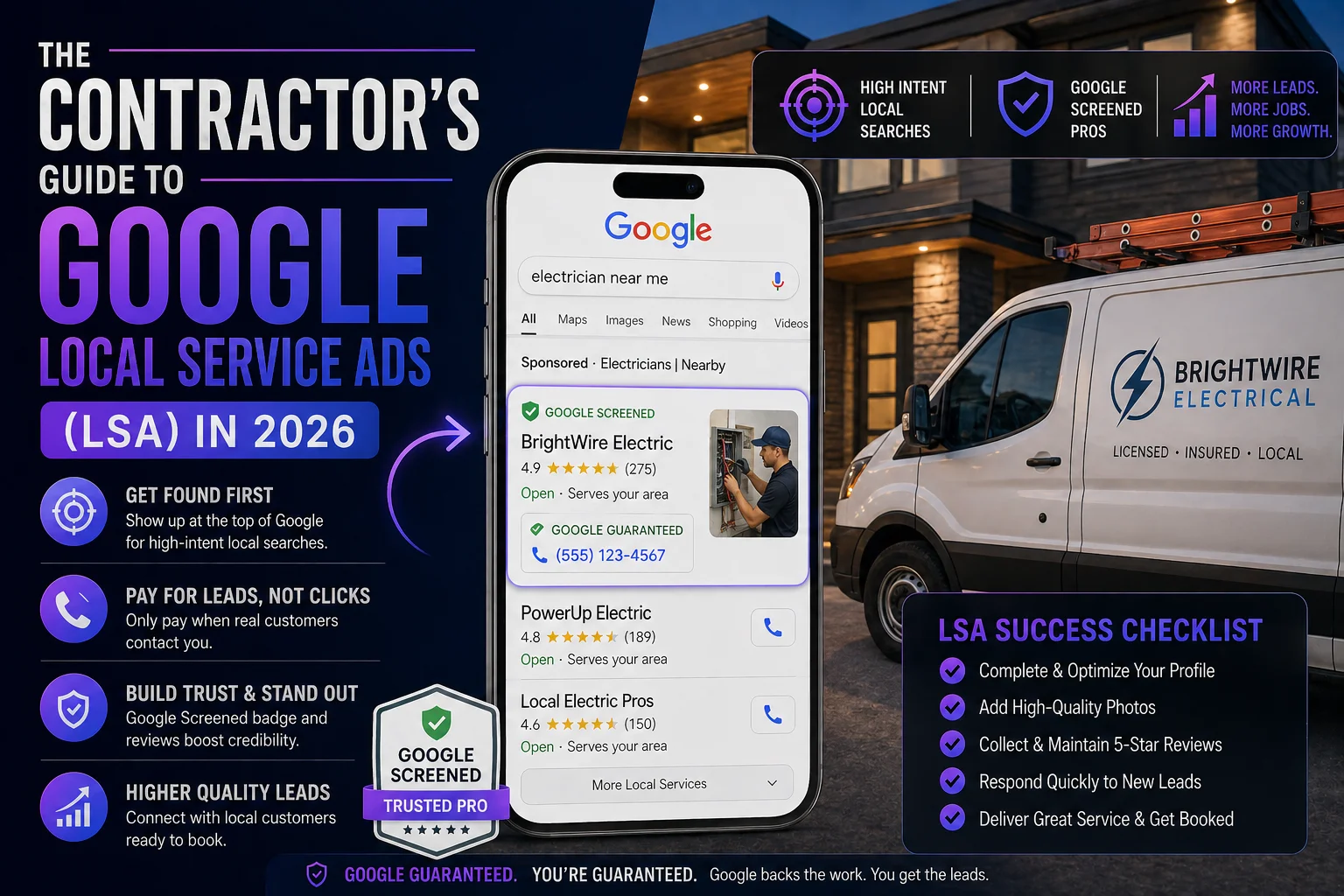
Local Service Ads, also called Google Guaranteed, are the small green-checkmark listings that show above normal Google search results when someone types “roofer near me” or “pool builder [city].” They’re the most valuable real estate on Google for contractors. They’re also the single most underused channel by contractors who tell us they “tried Google and it didn’t work.”
We manage LSA accounts for contractors across roofing, general remodeling, pool builds, and HVAC. The contractors winning at LSA in 2026 are not running cleverer ads, they’re running a system around reviews, lead disputes, and response time. This is that system.
Quick Answer
Google Local Service Ads (LSA) are pay-per-lead ads that appear at the top of Google search for service-based businesses.
- You pay only when a qualified lead contacts you (call, message, or booking), not per click
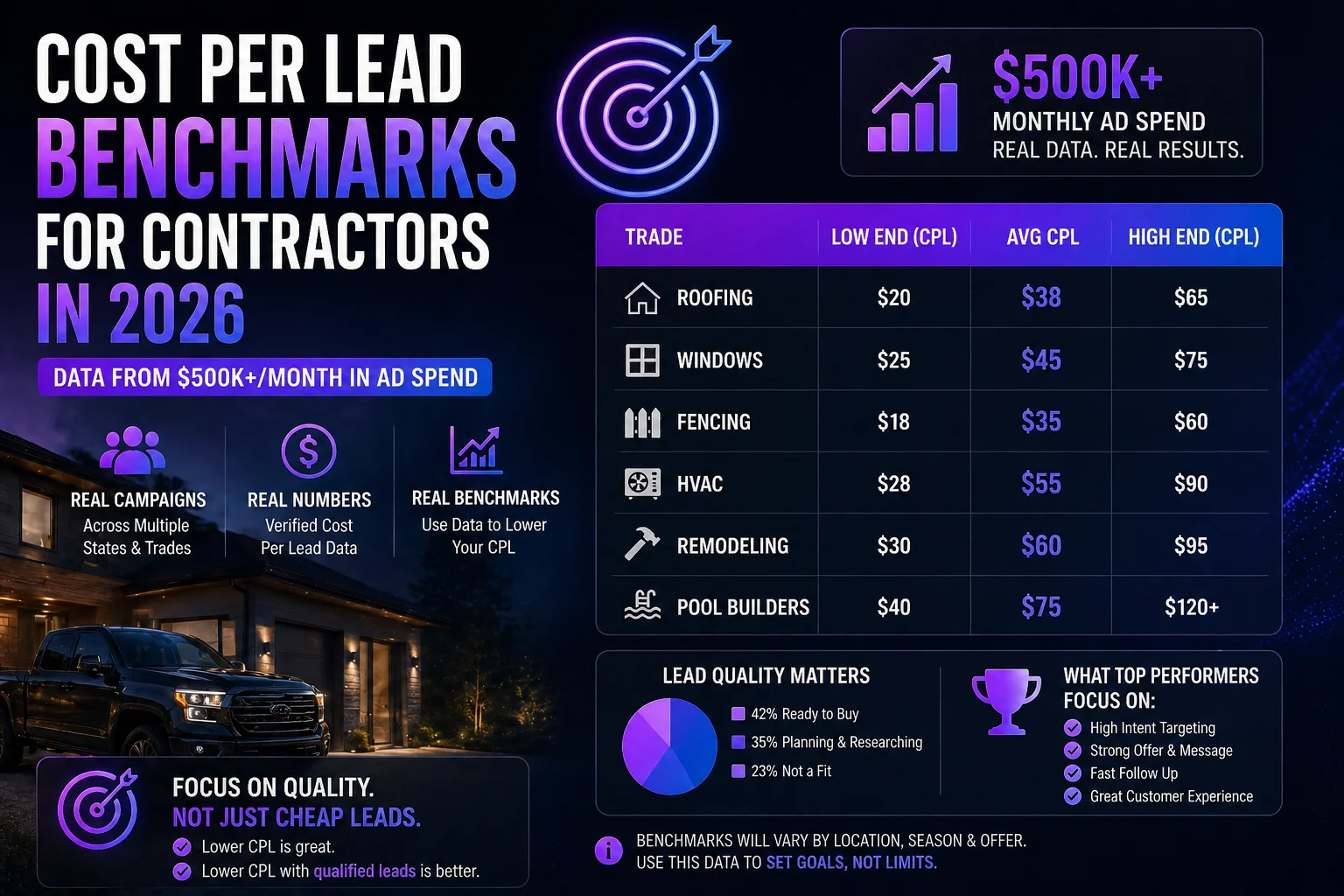
- Average contractor LSA cost-per-lead in 2026: $25–$120, depending on category and market
- Eligibility requires a Google background check, valid license, insurance, and a Google Business Profile
- Reviews are the #1 ranking factor, 5-star count and recency dominate placement
- You can dispute and reclaim charges for unqualified leads (this is where most contractors leave money on the table)
Table of Contents
- What Are Local Service Ads?
- LSA vs Google Search Ads vs Google Maps
- Who Qualifies (And What Google Checks)
- How LSA Pricing Actually Works
- The Review Strategy That Wins LSA
- Disputing Bad Leads (The Missed Money Lever)
- Combining LSA With Search and Facebook
- Common LSA Mistakes Contractors Make
- FAQ
What Are Local Service Ads?
Local Service Ads are Google’s pay-per-lead product for service businesses. Instead of bidding on keywords like a normal Google Search ad, you set a weekly lead budget. Google shows your business at the top of search results when someone in your service area searches for what you do, and charges you only when a real person contacts you.
The “Google Guaranteed” badge that appears on the listing is awarded after Google verifies your license, insurance, and runs background checks on the business. For homeowners, that badge is a major trust signal, Google has effectively pre-vetted you. For contractors, it’s a moat: not every competitor will pass the checks.
LSA listings include your business name, star rating, total review count, hours, service area, a “Call” button, and a “Message” button, all above the standard search results and the Google Maps pack.
LSA vs Google Search Ads vs Google Maps
These three Google products look similar from a homeowner’s perspective but are completely different products from yours.
Local Service Ads (LSA)
- Pay per lead (call/message)
- Google-Guaranteed badge
- Reviews are the dominant ranking factor
- Limited customization (no headlines, no creative)
- Highest-intent placement on Google
Google Search Ads
- Pay per click
- Headline and ad copy customization
- Keyword bidding
- Quality Score / Ad Rank ranking
- Higher control, requires more management
Google Maps / Google Business Profile
- Free organic listing
- Local SEO ranking based on proximity, relevance, prominence
- Reviews and posts boost ranking
- No direct lead cost but indirect (time invested in optimization)
Which to run
The answer for nearly every contractor: all three, layered. LSA captures the highest-intent searches, Search Ads cover keyword variations and competitive markets where your LSA budget runs out, and Google Business Profile drives free organic traffic that compounds month over month.
Who Qualifies (And What Google Checks)
Not every contractor can run LSA. Google verifies the following before activating an account.
What Google checks
- License, must match your service category (e.g. roofing, GC, plumbing) and your state/region
- Insurance, general liability, often $1M minimum depending on category and state
- Background check, both the business and the business owner; in some categories, all on-site employees
- Identity verification, government ID for the business owner
- Google Business Profile, must be verified and active
- Customer reviews, Google pulls reviews from your Google Business Profile
Categories with the strictest requirements
- General contracting (license + insurance varies by state)
- Plumbing and HVAC (state license)
- Electricians (state license)
- Pool builders (state contractor license + insurance)
Common reasons contractors fail eligibility
- License expired or doesn’t match category
- Insurance policy below state minimum
- Owner has not completed background check
- Google Business Profile is unverified
- Business name doesn’t match license records
The eligibility process can take 1–4 weeks. Plan accordingly, do not assume you can spin up LSA in 48 hours.
How LSA Pricing Actually Works
LSA pricing confuses most contractors because it is not pay-per-click. Here’s how it actually works in 2026.
The mechanics
- You set a weekly budget (Google recommends a number, you can adjust)
- You’re charged per qualified lead, a phone call, message, or booking from someone in your service area asking about your services
- Cost per lead varies by category and market, typically $25–$120
- Google may pause your ads when you hit your weekly budget, then resume the following week
What counts as a chargeable lead
- Phone call over 30 seconds (Google’s threshold) about your service
- Text message inquiry about your service
- Booking made through the LSA booking integration
What does not count (and should be disputed)
- Wrong-number calls
- Spam calls / robocalls
- Calls about services you don’t offer
- Calls from outside your service area
- Existing customers calling for support
- Pocket dials and silent calls
The dispute process is where most contractors leave money on the table, see the dispute section below.
How rank is determined
Google does not publish a formula but the heavy weights are well-documented:
- Review count and rating (5-star reviews, recency)
- Response rate (how often you answer the call/message)
- Response time (how fast you answer)
- Service area proximity to the searcher
- Profile completeness (services, hours, photos)
- Account history (reliability over time)
Reviews and response time dominate. Everything else is secondary.
The Review Strategy That Wins LSA
If you remember one thing from this post: reviews are the LSA ranking algorithm. A contractor with 80 5-star reviews will out-rank a contractor with 20, all else equal, and “all else equal” rarely matters because the gap compounds.
What to optimize
- Total Google reviews count (only Google reviews count for LSA, not Yelp, BBB, Facebook, or other platforms)
- Average rating (4.7+ minimum, 4.9+ ideal)
- Recency (Google weights recent reviews more heavily, 30 reviews in the last 90 days beats 200 reviews from 5 years ago)
- Response rate (reply to every review, positive or negative, Google sees the engagement)
How to get more reviews systematically
- Send a review-request SMS within 2 hours of job completion (highest response rate)
- Use a direct Google review link, don’t make customers search for your profile
- Ask twice, initial SMS, then follow-up email 5–7 days later to non-responders
- Train techs to mention reviews in person (“If you’re happy with the work, a Google review would mean a lot, I’ll text you the link”)
- Track review request → review conversion so you know which crews are best at it
What to avoid
- Asking customers to leave reviews on a tablet at your office (Google can detect IP-clustered reviews and discount them)
- Buying reviews (catastrophic, Google can suspend the LSA account permanently)
- Asking only happy customers (selection bias is fine, but be careful, Google’s TOS technically discourages “review gating”)
- Ignoring negative reviews, your response is more visible than the review itself
Recency benchmark
- 0–10 reviews in last 90 days: weak position, you’ll lose to most competitors
- 20–40 reviews in last 90 days: competitive
- 60+ reviews in last 90 days: dominant, you’ll show up first in most searches
Disputing Bad Leads (The Missed Money Lever)
This is the section most LSA articles skip and where most contractors leak money. Google charges you for leads that should not be charged. You are entitled to dispute them. Most contractors don’t.
What’s eligible to dispute
- Spam or robocalls, common, must be disputed quickly
- Wrong-number calls, easy disputes
- Out-of-area calls, calls from outside your stated service zip codes
- Calls about services you don’t offer, e.g. someone calls a roofer asking about gutters when you don’t do gutters
- Existing customer calls, current/past customers calling for support, warranty, scheduling
- Pocket dials / silent calls, under 30 seconds is auto-excluded; longer pocket dials need manual dispute
- Repeat caller from same number within a short window, only the first call should be charged
How to dispute
- Inside the Local Services Ads dashboard, find the lead
- Click “Dispute” within 30 days of the charge
- Select the reason and add a brief note
- Most disputes are auto-approved within 5–7 business days
How much money this is
For a contractor running $5K/month in LSA spend, 15–25% of leads are typically disputable. That’s $750–$1,250/month of recoverable spend, over $10K/year, that contractors leave on the table because they don’t review and dispute leads weekly.
This is the highest-ROI 30-minute weekly task in your entire marketing operation. Set a Friday recurring calendar block to review the week’s leads and dispute every ineligible one.
Combining LSA With Search and Facebook
LSA alone is a strong channel. LSA + Search + Facebook is a moat.
How they layer
- LSA captures the very top of search for high-intent commercial queries
- Google Search Ads capture keywords LSA doesn’t cover (informational queries, longer-tail, branded searches)
- Google Business Profile + local SEO drives free organic traffic month after month
- Facebook / Instagram generates demand from prospects who weren’t actively searching yet, and feeds them into your retargeting funnel
The full-funnel mechanics
A homeowner sees your Facebook ad showing a finished roof job. Three days later, hail hits their neighborhood. They search “roofer near me.” Your LSA listing appears at the top with your 5-star reviews. They tap “Call.” You answered in 30 seconds. They book.
That is a single conversion attributed to LSA, but it would not have happened without the Facebook ad three days earlier seeding recognition. This is why running channels in isolation under-performs every time.
Budget split
A reasonable starting allocation for a contractor at $20K/month total ad spend:
- LSA: $5K–$8K
- Google Search: $3K–$5K
- Facebook / Instagram: $7K–$10K
- YouTube or display retargeting: $1K–$2K
Adjust based on category, market competitiveness, and what’s working. Premium / longer-cycle services (pool builders, full remodels) skew more to Facebook. Urgent services (storm roofing, HVAC, plumbing) skew more to LSA and Search.
Common LSA Mistakes Contractors Make
After auditing dozens of LSA accounts, the same five mistakes show up over and over.
1. Ignoring missed calls
LSA penalizes accounts that don’t answer the phone. Every missed call hurts your future ranking. If you can’t answer 95%+ of calls inside 60 seconds during business hours, your LSA spend is being wasted.
2. Too narrow a service area
Many contractors set their service area to 5 zip codes when they actually service 25. Smaller area = fewer impressions = less spend = less ranking momentum. Set your service area as wide as you can realistically service.
3. Generic services list
LSA shows your selected services to searchers. Picking only “general contractor” when you do roofing, kitchens, baths, and additions cuts your impression volume in half. Pick every service you actually offer.
4. Not disputing leads
See above. Costing most contractors 15%+ of their LSA spend.
5. Treating LSA as set-and-forget
LSA needs weekly maintenance: review leads, dispute bad ones, respond to reviews, update services if you’ve expanded, monitor weekly budget pace. Contractors who don’t get 30 minutes a week to LSA management consistently underperform.
FAQ
How much do Local Service Ads cost for contractors?
Cost per lead ranges from $25–$120 in most contractor categories in 2026. Roofing, HVAC, and plumbing tend to be on the higher end. General handyman services tend to be lower. Total monthly spend is whatever you set as a weekly budget, multiplied out.
Are Local Service Ads worth it for contractors?
For most contractors, yes. The pay-per-lead model means you’re not paying for clicks that don’t convert, and the placement above standard search results is the most valuable real estate on Google. Contractors with strong review profiles tend to see 8–15x ROAS on LSA.
How long does it take to get approved for LSA?
Typically 1–4 weeks, depending on how fast you complete the background check, license verification, and insurance documentation. Plan for at least 14 days.
What’s the difference between Google Local Service Ads and Google Ads?
LSA charges per lead, has a Google Guaranteed badge, and ranks based heavily on reviews. Google Ads (search) charges per click, requires keyword bidding and ad copy, and ranks based on Quality Score and bid. They’re complementary, not interchangeable.
Can I run LSA without a license?
In most contractor categories, no. Google requires the license that matches your category in your state. Some categories (cleaning, lawn care) don’t require a license, but the trades almost always do.
How do I rank higher in Local Service Ads?
Three levers: (1) get more recent 5-star Google reviews, (2) answer the phone fast and don’t miss calls, (3) make sure your services list is comprehensive and your service area is wide.
What happens if I don’t answer an LSA call?
Google flags missed calls and uses them as a ranking signal. Repeated missed calls hurt your placement and can lead to suspension. Voicemail does not count as answering.
Can LSA leads be exclusive to my business?
No. Google sends the same lead to multiple businesses simultaneously in most cases, first to respond usually wins. This is why speed-to-lead matters more on LSA than almost any other channel.
The Bottom Line
Local Service Ads are the single most underused channel by contractors who told us “Google didn’t work for us.” It works, but only with the operational system around it: a review engine running weekly, a dispute review every Friday, and a phone-answering process that doesn’t drop calls during business hours.
The contractors who run that system are dominating their local LSA placement and printing leads at a fraction of what they used to pay on Search alone. The ones who don’t are paying Google for the privilege of losing leads to competitors who do.
Want help setting up the review and dispute system around your LSA account? Book a call and we’ll show you exactly how we run it for our clients.