Most contractor Facebook ad accounts we audit are leaking money in the same five places. After managing over $500,000 per month in contractor ad spend across roofing, pool building, general contracting, and remodeling, we’ve seen these mistakes cost operators anywhere from $3,000 to $40,000 per month in wasted budget. Fix these, and your cost per booked appointment drops fast, often within the first 10 days.
This guide breaks down the five most common Facebook ad mistakes contractors make in 2026, why each one quietly destroys ROI, and the exact fix we use on every account we take over.
Quick Answer
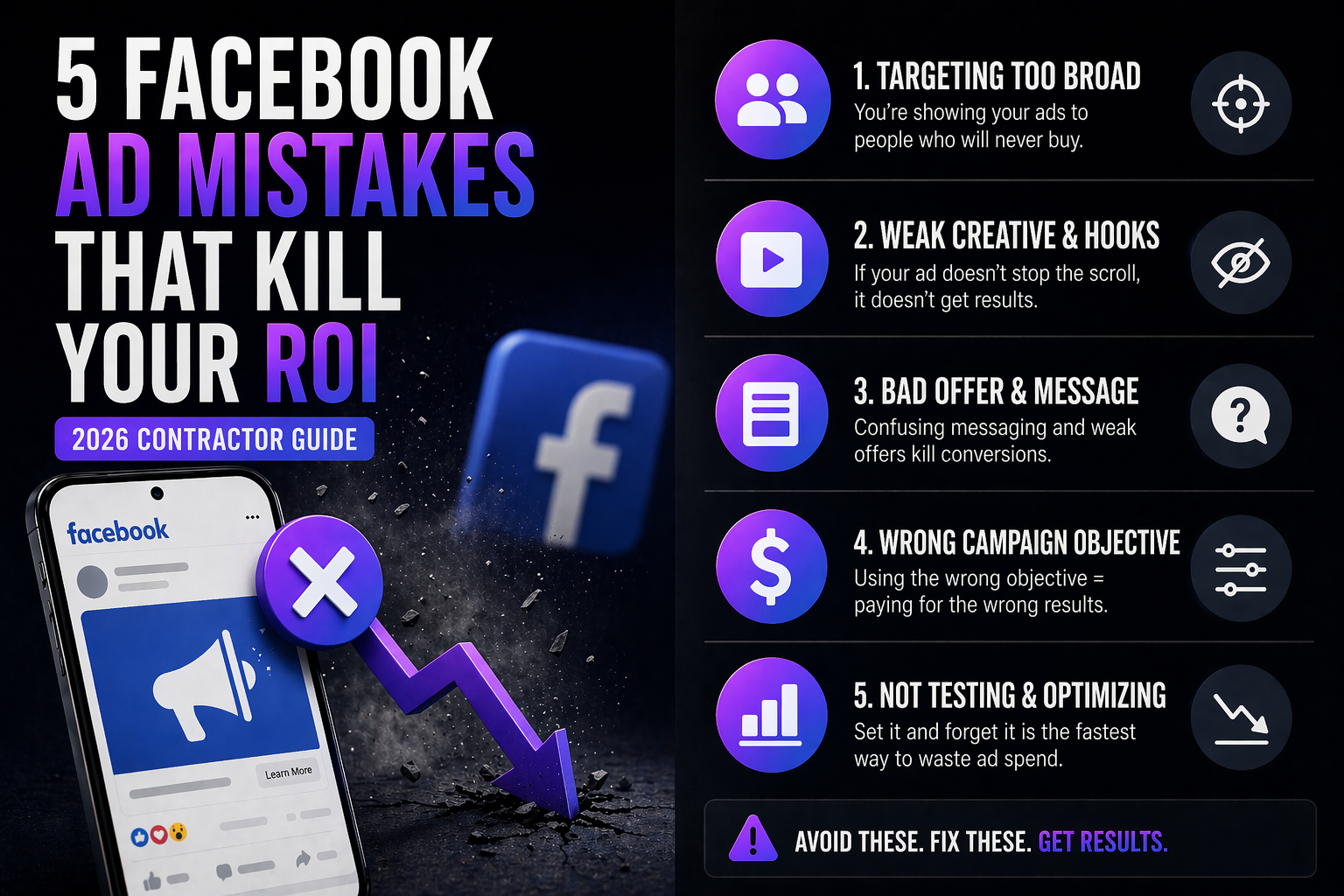
The 5 Facebook ad mistakes that kill contractor ROI are:
- Optimizing for the wrong conversion event
- Creative fatigue from running the same ads too long
- Over-narrow audiences that starve the algorithm
- No offline conversion tracking via the Conversions API
- Killing campaigns before the learning phase completes
Each of these is fixable in under a week if you know what to look for.
Table of Contents
- Mistake 1: Optimizing for the Wrong Event
- Mistake 2: Creative Fatigue
- Mistake 3: Audiences That Are Too Narrow
- Mistake 4: No Offline Conversion Tracking
- Mistake 5: Killing Campaigns Too Early
- How to Audit Your Own Ad Account
- FAQ
Mistake 1: Optimizing for the Wrong Event
The fix: Optimize for a bottom-of-funnel event, booked appointments or qualified leads, not clicks or form submissions.
If your campaign is optimizing for “Leads” (a form fill) or worse, “Link Clicks,” Meta will find you the cheapest clickers on the platform. Those are exactly the people who will never buy. Meta’s auction works by optimizing toward whatever event you define as success. Define success as “clicked a button,” and you’ll get clicks from bots, bored scrollers, and tire-kickers.
What to use instead
- Qualified Lead (lead passed through a basic qualification question, zip code, project timeline, budget range)
- Booked Appointment (lead actually scheduled a call or in-home assessment)
- Show (lead actually attended the appointment)
The further down the funnel you optimize, the better the lead quality. In 2026, Meta’s Advantage+ campaigns handle this better than manual campaigns, but only if you feed them the right signal.
Pro tip
If your pixel has fewer than 50 conversions per week on your target event, use value-based bidding with a custom conversion that includes both booked appointments and qualified leads. Meta needs enough volume to learn.
Mistake 2: Creative Fatigue
The fix: Rotate creative every 2–3 weeks. Aim for 6–10 active ads at all times.
The same three ads running for six months is a losing game. Creative fatigue is the single biggest cause of rising CPAs on accounts that used to perform well. Your audience sees the same ad too many times, stops paying attention, and your cost per booked appointment climbs 15–40% month over month.
How to tell if you have creative fatigue
- Frequency above 3.5 on your best-performing ad
- CPM rising while CTR drops
- The same ad that crushed 60 days ago is now underperforming
- Hook rate (3-second views) has dropped more than 20% from launch
What a healthy creative rotation looks like
- 2–3 short-form video ads (15–30 seconds, vertical, captioned)
- 1–2 UGC-style founder videos (the owner on a job site, no script)
- 1–2 static or carousel ads (before/after, social proof)
- 1 “trust” ad (team, process, guarantees)
Ship new creative every two weeks. Kill losers at 1x CPA. Scale winners.
Mistake 3: Audiences That Are Too Narrow
The fix: Broaden audiences to 1M–10M+ and let creative do the filtering.
Lookalikes at 1% sound smart until Meta runs out of people to show your ads to. Interest stacks with 12 overlapping behaviors sound precise until frequency hits 6 in a week. In 2026, the algorithm is better than your targeting. Your job is to give it room to work.
The modern contractor audience setup
- Geo: Full service area (not just one zip code)
- Age: 30–65 for most home-service verticals
- Interests: Either none (broad) or a single broad category like “Homeowners”
- Lookalikes: 3%–10% of closed-won customers, not 1%
Advantage+ Audience (Meta’s AI-driven targeting) outperforms manual interest stacking in roughly 80% of contractor accounts we test. Use it.
Why broad works
Meta has more data on who is about to re-roof their house than you will ever have. The algorithm uses intent signals (browsing behavior, home improvement searches, life events) you can’t target manually. When you hand it a narrow audience, you’re telling it to ignore those signals.
Mistake 4: No Offline Conversion Tracking
The fix: Send closed-revenue events back to Meta via the Conversions API (CAPI).
Booked jobs happen outside Facebook. A homeowner fills out a form, your call center books them, your sales rep closes the deal two weeks later. If you’re not sending that closed-won event back to Meta, the algorithm is optimizing blind, it thinks every lead is equal, so it keeps finding you cheap, low-quality leads.
What to track offline
- Booked appointment (when the call is scheduled)
- Showed (when they attended)
- Sold (when the contract was signed)
- Closed-won revenue (actual dollar value)
How to send it
- Native CRM integrations (GoHighLevel, HubSpot, SiloCRM)
- Zapier/Make workflows that fire CAPI events on pipeline stage changes
- Direct server-to-server implementation for full control
Contractors who implement offline conversion tracking typically see a 20–35% drop in cost per booked appointment within 30 days, because Meta finally knows who the good leads are.
Mistake 5: Killing Campaigns Too Early
The fix: Wait for 50 conversions inside the learning phase before judging a campaign.
Three days of data is noise, not signal. A campaign needs to exit the learning phase (50 optimization events in 7 days) before you can evaluate it. Kill it at day 3 because “it’s not working,” and you never gave the algorithm enough reps to actually start optimizing.
What the learning phase actually is
Meta needs around 50 conversions of your target event per ad set, per week, to stabilize performance. Until that happens, CPA, CTR, and CPM fluctuate wildly. Daily spend matters here, if your budget is too small to generate 50 conversions in a week, the campaign never exits learning, and you never get real performance data.
Budget math for the learning phase
If your target CPA is $100 (booked appointment), you need roughly $5,000 per ad set per week to exit learning in 7 days. If that’s out of reach, consolidate to fewer ad sets with higher budget rather than spreading $2k across five ad sets.
When it is okay to kill early
- The ad has zero conversions after $3x target CPA with 10,000+ impressions
- Hook rate is below 15% (creative is broken)
- The click-through-rate is below 0.5% on cold traffic
How to Audit Your Own Ad Account
Run this 10-minute audit on your current account today:
- Check optimization event. Is it “Lead” or deeper (Qualified Lead, Booked Appointment)?
- Check creative age. Are your top 3 ads more than 30 days old?
- Check audience size. Are any ad sets under 500k reach?
- Check CAPI status. Go to Events Manager → Data Sources → Conversions API. Is it live?
- Check learning phase. Any ad set stuck in “Learning Limited”? That’s a structural issue.
If you fail three or more of these, your account is leaking real money right now.
FAQ
What is the biggest Facebook ad mistake contractors make in 2026?
The biggest mistake is optimizing for surface-level events like clicks or form fills instead of booked appointments or closed revenue. It trains the algorithm to find cheap clickers instead of real buyers.
How often should I change Facebook ad creative?
Rotate creative every 2–3 weeks, with 6–10 active ads at any time. Replace bottom performers weekly and ship fresh creative every 14 days minimum.
Should contractors use Advantage+ campaigns in 2026?
Yes, in most cases. Meta’s Advantage+ campaigns outperform manual campaigns for roughly 80% of contractor accounts we manage, especially once offline conversion tracking is in place.
What’s the minimum budget for Facebook ads to work for contractors?
You need roughly $3,000–$5,000 per month minimum to generate enough conversions to exit the learning phase. Below that, the algorithm can’t stabilize and results are inconsistent.
How do I know if my Facebook ads are actually profitable?
Track cost per booked appointment and closed-won revenue per dollar spent, not cost-per-lead or CTR. Those surface metrics hide the real profitability of an account.
What is the Conversions API and do I need it?
The Conversions API (CAPI) sends offline conversion events (booked appointments, closed deals) directly from your CRM back to Meta. It’s mandatory in 2026, without it, you’re flying blind and leaving 20–35% performance on the table.
The Bottom Line
Facebook ads work for contractors in 2026, but only for contractors running a tight account. The operators paying $40 per booked appointment and the operators paying $400 are often running on the same creative budget. The difference is almost always in these five fundamentals.
If you’re running Facebook ads right now and any of these mistakes sound familiar, you’re not alone, we see every single one of these in 80% of the accounts we audit. This is the kind of stuff we fix in the first two weeks of working with a new contractor client, usually with an immediate drop in CPA and a lift in booked appointments.
If you want a second set of eyes on your account, our team audits contractor ad accounts every week. Book a strategy call and we’ll tell you exactly what’s broken and what’s fixable, no fluff, no pitch deck.