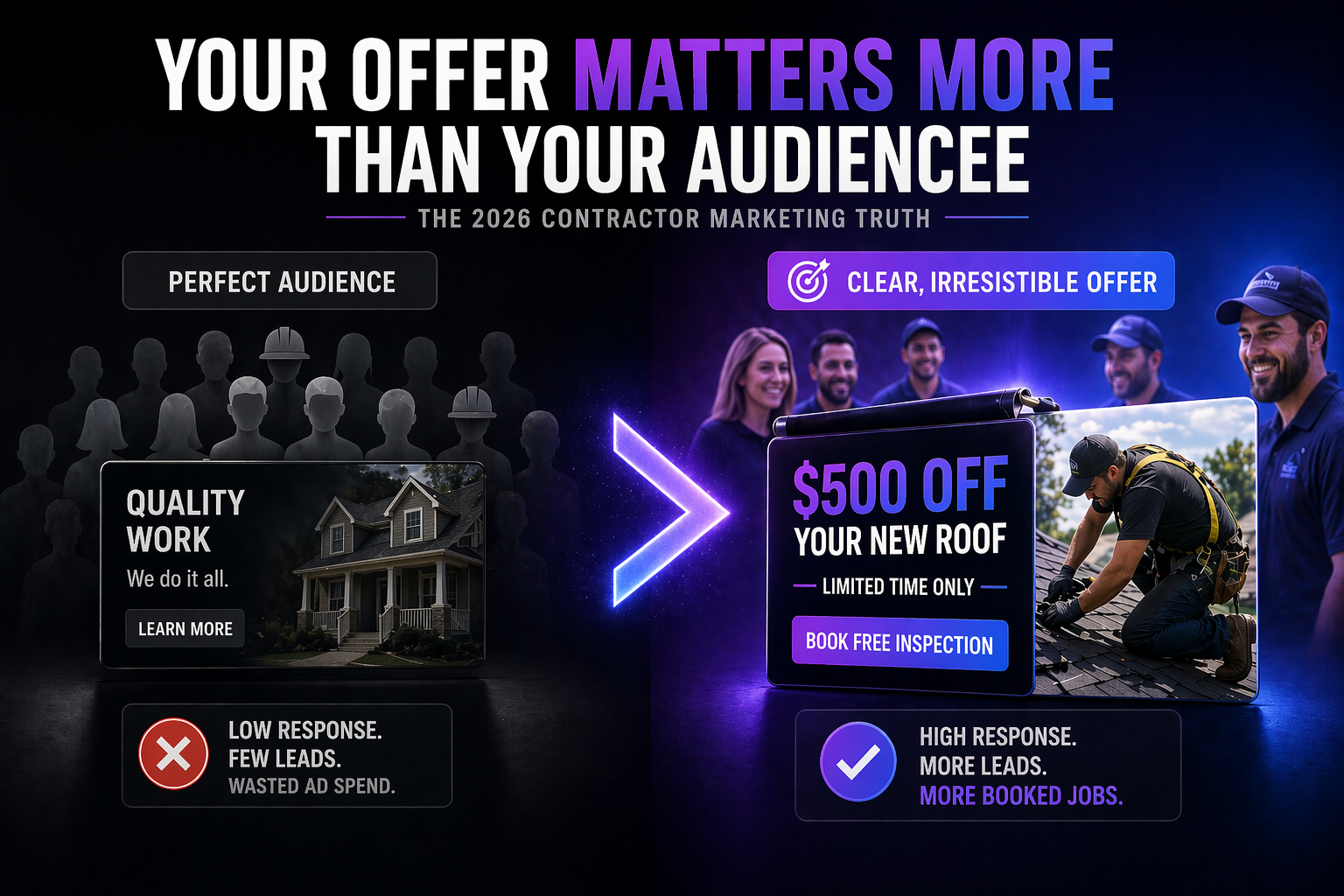
“Our Facebook ads aren’t working” is almost never an audience problem. Nine times out of ten, it’s an offer problem. After running ads for hundreds of contractors, and auditing hundreds more, we can tell you with high confidence that 80%+ of “the ads don’t work” complaints are actually “the offer doesn’t work” complaints in disguise.
If you’ve been burning weeks testing lookalike audiences, layering interests, or tweaking geos without meaningful movement, read this first. Your targeting probably isn’t the issue.
Quick Answer
The offer matters more than the audience in 2026 contractor marketing because:
- Meta’s AI now handles 80% of the targeting job for you
- The offer is what makes a stranger take action in 3 seconds
- A strong offer can win with a bad audience; a weak offer loses with a perfect one
- Offer changes are usually 10x more impactful than audience changes
The fastest test: Run the same ad creative with two different offers for 5 days. If one pulls 3x the form fills, your problem was never the audience.
Table of Contents
- Why Offer Beats Audience in 2026
- The Diagnostic Test: Offer or Audience?
- What a Strong Contractor Offer Looks Like
- What a Weak Offer Looks Like
- The Offer Framework We Use on Every Account
- How to Test a New Offer Cheaply
- Common Offer Mistakes
- FAQ
Why Offer Beats Audience in 2026
The world has changed. In 2018, precise audience targeting was a real lever. You could layer interests, build 1% lookalikes, and carve out niche segments that outperformed broad targeting by 30–40%.
That’s over.
In 2026, Meta’s Advantage+ and Google’s Performance Max have consumed most of what used to be manual targeting. The algorithms have more behavioral data on your ideal customer than you will ever manually define. Fighting them by narrowing audiences almost always hurts performance now.
What the algorithm cannot do is write your offer. It can’t decide that a “free 48-hour roof assessment with a written report” will outperform a “free estimate” by 4x. That’s still your job. That’s why it’s the lever that matters.
The single-variable test
If you change the audience, you might move CPBA by 10–20%. If you change the offer, you can move it by 300–500%. We’ve seen offer swaps drop cost per booked appointment from $180 to $42 overnight with identical targeting. The math is not close.
The Diagnostic Test: Offer or Audience?
Before you change anything, figure out which part of the funnel is actually broken.
Symptom-based diagnosis
- Ad gets impressions but no clicks → Creative/hook problem (not offer, not audience)
- Ad gets clicks but no form fills → Offer problem
- Ad gets form fills but no booked appointments → Offer-to-reality gap (offer overpromises)
- Ad gets booked appointments but no closes → Lead quality (audience) OR sales handoff
- Everything works but CPA is too high → Scale or creative fatigue, not offer
Most contractors look at “leads came in but didn’t close” and blame the audience. It’s usually the offer setting the wrong expectation. A “free roof inspection” attracts people who want a free inspection. A “free roof inspection with a written assessment for insurance documentation” attracts people who are preparing to file a claim.
Same traffic. Different outcome. The offer qualified them.
What a Strong Contractor Offer Looks Like
A strong offer has four non-negotiable components in 2026:
1. Specific outcome
The prospect should know exactly what they’re getting and what happens next.
- Weak: “Free estimate”
- Strong: “Free roof assessment with a written report in 48 hours”
2. Zero friction to claim
No phone call required to book. Pick a time on a calendar. Done. Every additional step between the ad and the booked appointment is a leak.
- Weak: “Call us to schedule”
- Strong: “Pick a time that works, we’ll text you a confirmation”
3. Risk reversal
Remove the reason to say no. The prospect should feel like claiming the offer costs them nothing and gains them something even if they don’t hire you.
- Weak: “Schedule a consultation”
- Strong: “If we don’t find at least one issue worth addressing, we’ll send you a detailed maintenance checklist you can use with any contractor.”
4. Urgency with a real reason
“Limited time offer” without a reason is noise. Urgency with a credible reason is a conversion engine.
- Weak: “Schedule today!”
- Strong: “Book before April 30, after that, our summer pricing kicks in and assessment slots fill 2 weeks out.”
What a Weak Offer Looks Like
If your offer reads like any of these, you have an offer problem:
- “Call for a free estimate”
- “Learn more about our services”
- “Schedule a consultation”
- “Get a quote today”
- “Contact us for a free assessment”
These aren’t offers. They’re polite requests for the prospect’s time with no clear value exchange. The prospect has to do the work of imagining what they’ll get and why it’s worth their Saturday morning. Most of them won’t.
Offers that don’t specify what the prospect receives, when they receive it, and what it costs them will underperform every single time.
The Offer Framework We Use on Every Account
On every new contractor account we take over, we rebuild the offer using a simple framework. You can apply it today.
The 5-part offer formula
- What, What exactly is the prospect receiving? (A written roof assessment, a 3D pool design, a detailed remodel scope and timeline.)
- When, How fast? (In 48 hours, by next Friday, within 5 business days.)
- Proof, Why should they trust the value? (Licensed inspector, 12 years of experience, 400+ completed projects.)
- Risk reversal, What do they get if they don’t hire you? (A free report, a price match, a satisfaction guarantee.)
- Reason to act now, Why book today instead of in six months? (Seasonal pricing, pre-storm scheduling, insurance timing.)
Plug those five components together, and you have an offer that does real work in a paid ad.
Example: Roofing offer using the framework
“Free roof assessment with a written report in 48 hours, conducted by our licensed inspector with photos, damage notes, and insurance-ready documentation. If we don’t find any damage, you keep the report to use with any contractor. Booking before April 30 locks in our spring inspection pricing; after that, we shift to 2-week lead times.”
That’s a full offer. It works in an ad. It works on a landing page. It works when the call center repeats it to qualify the lead.
How to Test a New Offer Cheaply
Before touching targeting, run the same ad with two offer variations for 5 days. This is the single highest-leverage test you can run on your ad account.
The setup
- Same creative (video or image)
- Same audience
- Same budget per ad set
- Only variable: the offer in the primary text and landing page headline
- Duration: 5 days minimum, or 100 form fills, whichever comes first
What “winning” looks like
- 2x–5x lift in form fills on the same spend
- Lower CPBA (cost per booked appointment)
- Higher show rate on the booked appointments (offer qualified them)
If one offer pulls 3x the form fills on the same audience, you just found the real problem. It was never the targeting.
Common Offer Mistakes
Mistake 1: Leading with a discount
“$500 off your roof replacement” sounds great until you realize you’re training the market to wait for discounts and devaluing your service. Save discounts for close-time objection handling, not top-of-funnel ads.
Mistake 2: Giving away too much in the offer
“Free design, free permits, free inspection, free consultation” sounds generous. It reads as “this guy has no pipeline and is desperate.” Offer one high-value thing, clearly.
Mistake 3: Offers that attract tire-kickers
“Free quote” with zero qualification questions attracts every curious homeowner in a 50-mile radius. Add 2–3 qualifying questions to the form (timeline, budget range, scope) without adding friction. You’ll get fewer leads but 3x the close rate.
Mistake 4: Offers that overpromise
“Full roof replacement starting at $3,999” might get the click, but when the actual quote comes in at $18k, the prospect feels baited-and-switched and walks. Your offer should set expectations that match reality.
Mistake 5: Never changing the offer
The same offer for two years is a dead offer. Seasons change, competitors copy, markets saturate. Refresh the offer every 90 days minimum. We refresh ours every 30–60 days on high-spend accounts.
FAQ
What’s more important: offer or audience?
In 2026, the offer is dramatically more important than the audience. Meta and Google’s AI now handle most targeting automatically, so the offer is the biggest variable you still control. Offer changes can move cost-per-booked-appointment by 300–500%; audience changes typically move it by 10–20%.
How do I know if my offer is weak?
If your offer sounds like “free estimate,” “free consultation,” or “call for a quote,” it’s weak. Strong offers specify exactly what the prospect receives, when they receive it, what it costs them, and why they should act now.
How often should contractors update their offer?
Refresh the core offer every 30–90 days depending on ad spend. High-spend accounts (over $20k/month) should test new offer variations every 30 days. Lower-spend accounts can refresh every 60–90 days.
Should I offer a discount in my ad?
Generally, no. Leading with discounts trains your market to wait for deals and devalues your service. Use discounts for close-time objection handling, not top-of-funnel lead generation.
What’s the best contractor offer in 2026?
The best offers are specific, fast, and risk-reversed. Examples: “Free roof assessment with written report in 48 hours,” “Free 3D pool design with pricing in 5 business days,” “Free remodel scope and timeline in one 30-minute call.” Specificity and speed beat generosity.
How do I test a new offer?
Keep your creative, audience, and budget identical. Change only the offer in the ad copy and landing page. Run for 5 days or until 100 form fills. The offer that produces more booked appointments (not just form fills) wins.
The Bottom Line
Most contractor marketing problems aren’t marketing problems. They’re offer problems wearing a marketing costume. Before you blame your agency, your algorithm, or your audience, rewrite your offer using the five-part framework in this post and test it for five days. If it works, you just saved yourself six months of targeting experiments. If it doesn’t, at least you can rule it out.
We rebuild offers on every new account we take over. It’s usually the first thing we touch, and usually the thing that moves the numbers the most. If you want help pressure-testing yours, book a strategy call and we’ll walk through your current offer against what’s working across our portfolio.