A cinematic drone shot of a finished roof doesn’t book jobs. A 15-second ad that names a specific problem in the first 2 seconds does.
We’ve tested thousands of contractor video ads across Meta, YouTube Shorts, and TikTok, managing over $500,000 per month in contractor media spend. The video ads that convert look nothing like the polished “brand videos” most contractors pay thousands to produce. In 2026, the winning format is a 15-second, vertical, founder-on-camera ad shot on an iPhone, not a 60-second commercial with drone footage and a voiceover.
This is the script structure, hook formula, and production approach that consistently outperforms in our accounts.
Quick Answer
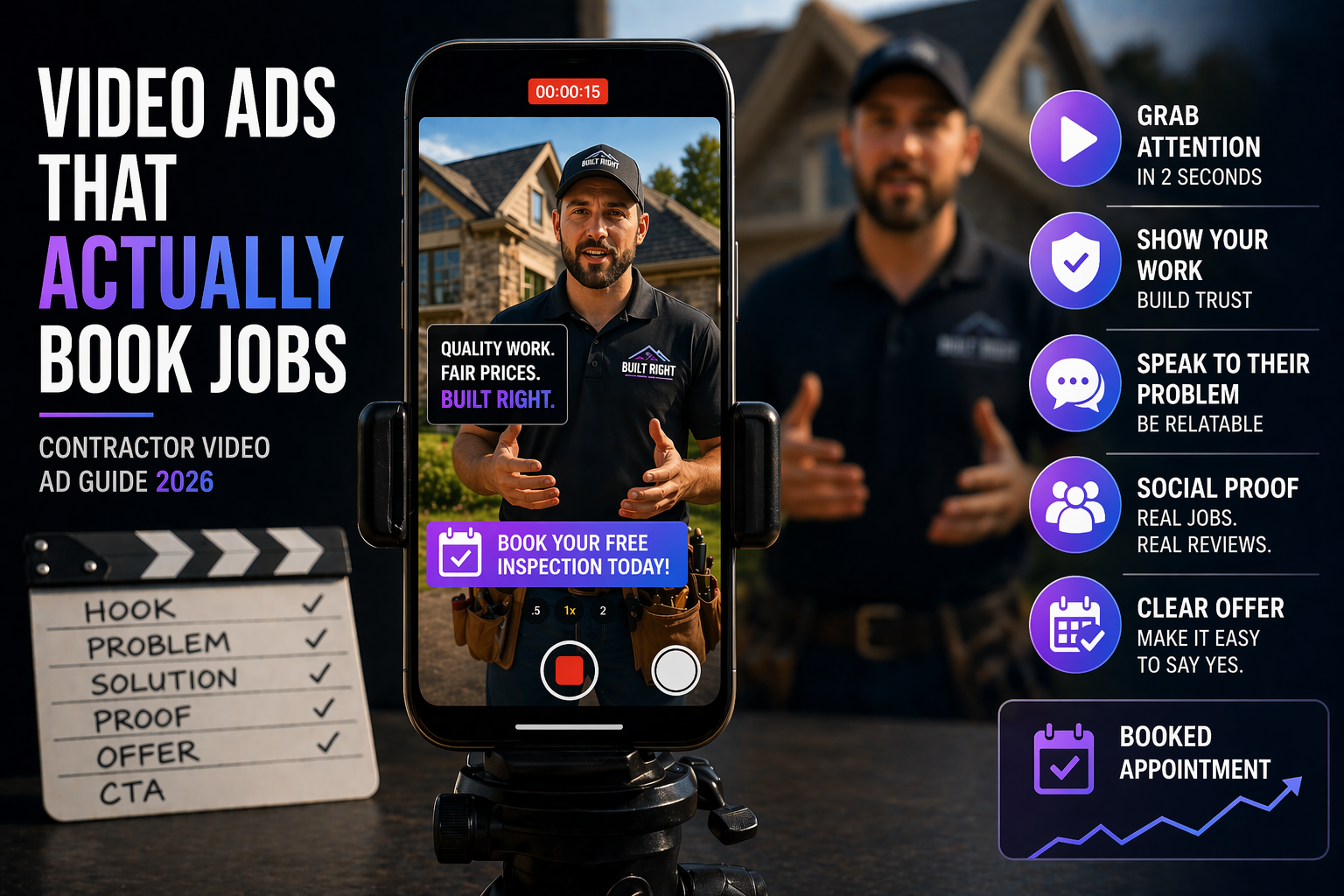
High-performing contractor video ads in 2026 follow a simple formula:
- Pattern interrupt in the first 2 seconds (problem, damage, or a specific question)
- Proof in the next 8 seconds (on-camera talent on a real job site explaining the problem)
- Direct CTA in the last 5 seconds (one specific, low-friction action)
Total length: 15–30 seconds. Format: vertical (9:16), captioned, shot on iPhone or Android.
Table of Contents
- Why Most Contractor Video Ads Fail
- The 3-Beat Video Ad Structure
- Hooks That Stop the Scroll
- What Makes a Video Actually Convert
- Production Rules for Contractor Video Ads
- The Metric That Matters: Hook Rate
- Examples by Vertical
- FAQ
Why Most Contractor Video Ads Fail
They’re built like TV commercials.
Wide shots, music swell, voiceover, logo animation at the end. That format was designed for a captive audience who couldn’t skip. In the Facebook or Instagram feed, that same ad is invisible, the viewer scrolls past it in 1.3 seconds because nothing in the first frame demands attention.
The other failure mode is the “vision video.” Your team riding in trucks, happy families, drone shots of finished houses set to an acoustic guitar track. It feels premium. It tells the viewer nothing. It books zero jobs.
Why this format keeps getting produced
Because contractors keep hiring videographers instead of direct-response marketers. A videographer optimizes for “looks great.” A direct-response marketer optimizes for “books appointments.” Those are different jobs with different skill sets.
The ads that convert are often uglier than the ads that don’t. That’s not a bug. It’s the whole point.
The 3-Beat Video Ad Structure
Every high-performing video ad we run follows the same three beats.
Beat 1: Pattern Interrupt (0–2 seconds)
The hook has one job: stop the scroll. You have 2 seconds to convince the viewer this ad is worth their attention. Ways to do it:
- Name the problem out loud: “If your shingles look like this, you have 6 months before a leak.”
- Show the damage on screen: Close-up of cracked tiles, a sagging gutter, a pool with green water.
- Ask a question they’re already asking: “How do you know if your roof needs to be replaced or just repaired?”
- Show a specific number or cost: “The difference between a $6k repair and a $30k replacement.”
What doesn’t work: Your logo, your business name, a slow zoom on a house, “At [Company] we believe in quality.” You’ve lost them.
Beat 2: Proof (2–10 seconds)
Once you have their attention, you need 8 seconds of credibility. On-camera, real job site, real talent. This is where most “produced” ads fail, they cut to B-roll and voiceover. The viewer disengages.
What works:
- Owner or lead tech walking a real job site
- Explaining what they found, what they did, why it mattered
- Pointing at specific damage, specific work, specific outcomes
- Talking to the camera like they’re explaining something to a neighbor
This beat builds trust. It doesn’t need to be pretty. It needs to be real.
Beat 3: Direct CTA (10–15 seconds)
One specific next step. Never “learn more.” Always something like:
- “Tap below to book your free roof assessment, we’ll have a report to you in 48 hours.”
- “Pick a time on the calendar, no phone call needed.”
- “Click to get your custom pool design back in 5 business days.”
The CTA should be specific enough that the viewer knows exactly what happens after they click, how long it takes, and what they get.
Hooks That Stop the Scroll
The hook is the single highest-leverage variable in the entire ad. Get it right, everything downstream improves. Get it wrong, nothing else matters.
Hook formulas that consistently work
-
“If you have [specific trait], this is for you.”
- “If you have a roof over 10 years old in Houston, this is for you.”
-
“Here’s what’s actually happening with [specific problem].”
- “Here’s what’s actually happening under your shingles during a storm.”
-
“The difference between [cheap outcome] and [expensive outcome].”
- “The difference between a $6k repair and a $30k replacement.”
-
“Most [homeowners / people / contractors] don’t know…”
- “Most pool owners don’t know their concrete is cracking in one specific spot first.”
-
Pattern-interrupt statement
- “Stop getting quotes for your roof until you watch this.”
-
Specific number / price / timeline
- “We just finished a roof in 72 hours for $14,200. Here’s how.”
Hooks that don’t work
- “Are you looking for a reliable contractor?” (Everyone is, this says nothing)
- “We’ve been serving [city] for 25 years.” (Nobody cares in the first 2 seconds)
- “Welcome to [Company Name].” (This is the format of a 1998 corporate video)
- Anything that opens with your logo
What Makes a Video Actually Convert
The difference between an ad that gets views and an ad that books jobs is the proof beat. This is where most contractors lose the viewer.
The three rules of the proof beat
- Real job sites beat stock footage, always, every time
- The owner on camera beats a hired actor, people buy from people they trust
- Specificity beats polish, “we found three loose flashings near the chimney” beats “we do quality work”
What specificity sounds like
- “We pulled up these three shingles and you can see the wood underneath is rotting.”
- “The pool was losing about 3 inches of water a week, we found the leak here.”
- “This homeowner was quoted $42k by a competitor. We did the same job for $28k.”
Specificity creates trust faster than any testimonial card or 5-star review ever will.
Production Rules for Contractor Video Ads
Shoot on a phone
iPhone 15 Pro or newer. Android equivalent. That’s it. 4K video is more than enough. Stop paying $5,000 for a “professional” shoot, the top-performing contractor ads on Meta in 2026 are shot on phones by the owner.
Shoot vertical (9:16) first
Horizontal is dead for paid social. Shoot vertical, then crop down to square or horizontal for YouTube if needed. If you only have one version, vertical wins.
Caption everything
85%+ of social video is watched with sound off. If your ad relies on audio, it’s already lost. Burn captions into the video. Use a captioning tool (CapCut, Descript, Submagic).
Cut fast
Every 2–3 seconds, change the shot. Static shots longer than 3 seconds cause drop-off. Even if it’s the same person talking, cut to a different angle or zoom level.
Keep it under 30 seconds
15 seconds is ideal. 30 seconds is the ceiling. Anything longer and drop-off compounds past the point where the CTA matters.
B-roll is cheap currency
Walk your job sites with a phone on a gimbal and collect 30 minutes of raw footage every week. You’ll never run out of proof shots.
The Metric That Matters: Hook Rate
Hook rate is the percentage of people who watch at least 3 seconds of your video. In Meta Ads Manager, this is “3-second video plays / impressions.”
If your hook rate is below 30%, nothing else in the funnel matters, the ad isn’t being watched. Fix the first 2 seconds and everything downstream improves.
Hook rate benchmarks by vertical
- Roofing: 30–45% is healthy, 50%+ is excellent
- Pool builders: 35–50% is healthy (visual vertical)
- Remodeling / GC: 28–40% is healthy
- HVAC / plumbing: 25–40% (lower because of urgency-driven problem framing)
How to fix a low hook rate
- Change the first frame, what the viewer sees in frame 1
- Change the first sentence, what they hear or read in the first second
- Add on-screen text overlay naming the problem in the first second
- Cut the first 2 seconds entirely and start from second 3
We rewrite hooks weekly on every account we run. It’s the single most impactful creative change you can make.
Examples by Vertical
Roofing
- Hook: “If your roof is over 10 years old, you need to look at this.”
- Proof: Owner on a job site pointing at granular loss on a shingle, explaining what it means.
- CTA: “Tap below for a free roof assessment. Licensed inspector. Written report in 48 hours.”
Pool builders
- Hook: “Most pool quotes are missing one thing that costs homeowners $20k+ later.”
- Proof: Owner walking a pool site explaining equipment pad placement.
- CTA: “Click to get your 3D custom pool design, no phone call needed.”
Remodeling
- Hook: “This kitchen was done in 23 days. Here’s how.”
- Proof: Time-lapse of the actual job with owner narration.
- CTA: “Book a 30-minute scope call. We’ll send pricing and timeline within 5 business days.”
General contracting
- Hook: “Here’s why your contractor quote is always 40% higher than the last one.”
- Proof: Owner breaking down line items from an actual quote.
- CTA: “Get a transparent, itemized quote, no upsell. Click below.”
FAQ
How long should a contractor video ad be in 2026?
15–30 seconds is the ideal range for paid social. 15 seconds outperforms most of the time. Anything over 30 seconds sees steep drop-off that hurts conversion rates.
Should contractor video ads be vertical or horizontal?
Vertical (9:16). Over 90% of Meta and TikTok video views are on mobile. Vertical outperforms horizontal by 2–3x in our testing.
Do contractor video ads need professional production?
No, and often they perform worse with it. Phone-shot, owner-on-camera ads regularly outperform professionally produced ads in contractor verticals. Authenticity beats polish.
What’s a good hook rate for a contractor video ad?
30% or higher is healthy. 50%+ is excellent. If you’re under 30%, the first 2 seconds of your ad are broken.
Should contractor video ads have music?
Music can help but isn’t required. If you use music, keep it subtle and under the voiceover. Most videos are watched with sound off, so captions matter more than audio.
What’s the best platform for contractor video ads?
Meta (Facebook + Instagram) is still the highest-volume platform for contractor video ads in 2026. YouTube Shorts and TikTok are growing fast for certain verticals (pool builders, remodeling, high-end GC).
How often should I refresh contractor video ads?
Every 2–3 weeks. The same video running for 6 months is a losing strategy. Rotate 6–10 active creatives at all times and replace bottom performers weekly.
The Bottom Line
The video ads that book contractor jobs in 2026 are shorter, uglier, more specific, and more real than what most businesses produce. They’re shot on phones, edited in under an hour, and built around one strong hook and one clear CTA. The production budget doesn’t matter. The format does.
Stop paying videographers to make you commercials. Start making 15-second videos that name a real problem, show real work, and ask for one specific action. If you want help building a video ad engine that produces winners week after week, book a call, we’ll show you the exact system we run on $500k+ per month in contractor media spend.