Speed-to-lead isn’t a “nice to have.” It’s the difference between a profitable ad campaign and a money-losing one. We’ve managed over $500,000 per month in contractor ad spend, and the single strongest predictor of ROAS across every account we’ve ever touched isn’t targeting, creative, or budget, it’s how fast the business calls the lead back.
If you take one thing from this post: the gap between a 5-minute response time and a 1-hour response time is not 12x. It’s often 20x–100x in conversion rate. This is the math nobody wants to do, so most contractors don’t. This post does it.
Quick Answer
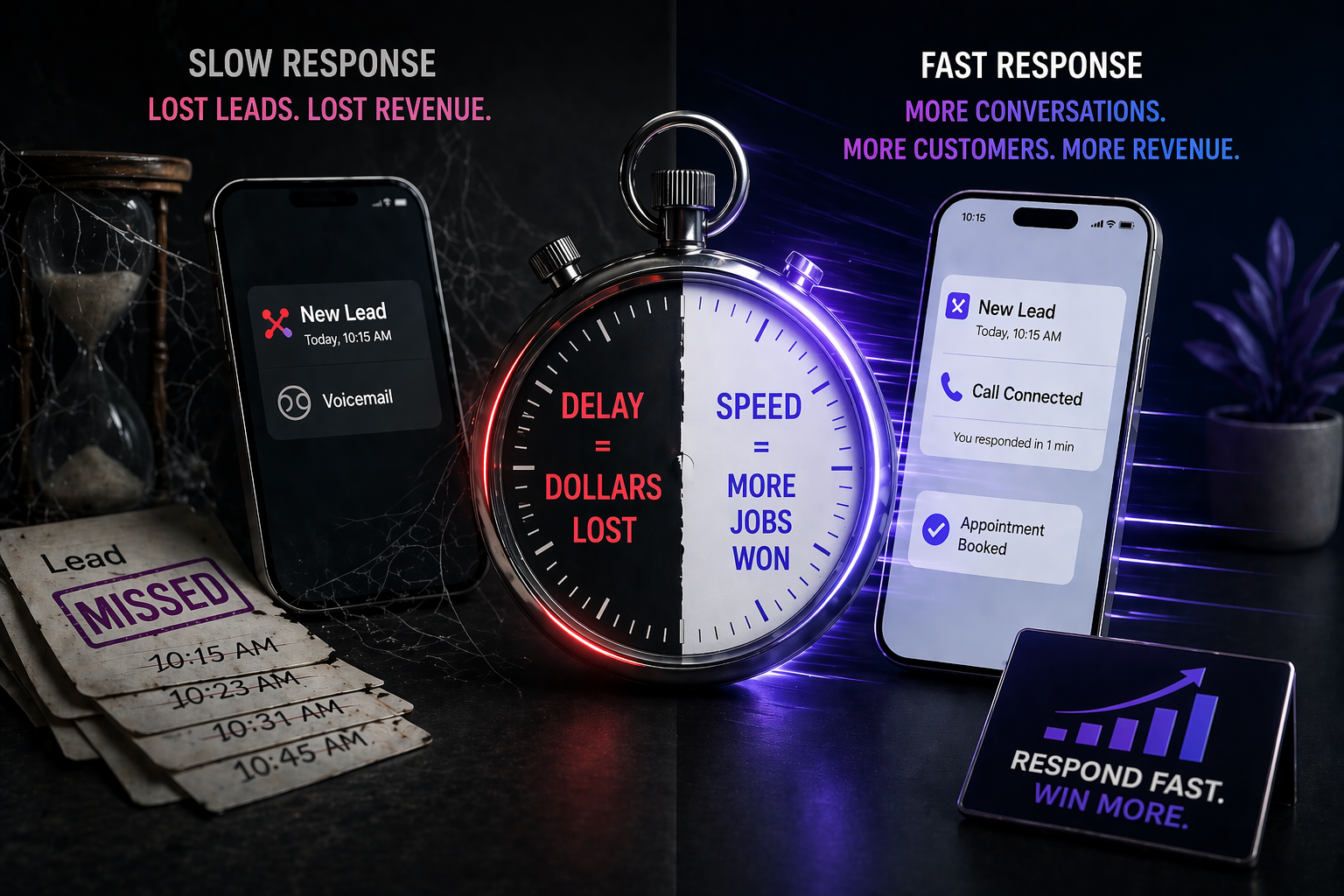
Speed-to-lead is how fast you contact an inbound lead after they submit a form or make a call.
- Leads contacted within 5 minutes are ~100x more likely to convert than leads contacted after 30 minutes
- The average contractor response time is over 24 hours
- A 24-hour response time typically costs contractors 60–75% of potential revenue already paid for by ad spend
- The fix is structural (live call center + automation), not “tell the team to respond faster”
Table of Contents
- What Is Speed-to-Lead?
- The 5-Minute Window (The Data)
- What Slow Response Actually Costs You
- Why Most Contractors Are Slow
- What “Fast” Actually Looks Like
- How to Fix Speed-to-Lead in Your Business
- Metrics to Track
- FAQ
What Is Speed-to-Lead?
Speed-to-lead is the time between when a prospect submits an inquiry (form fill, phone call, web chat) and when your business actually speaks to them live. It is not the time to send an auto-reply email. It is not the time to schedule a callback. It is time-to-live-conversation.
The distinction matters because the data is clear: auto-replies and scheduled callbacks do not move conversion rates. Live conversation does. Prospects are in a high-intent window for roughly 5 minutes after submitting a form, and after that, they’re looking up your competitor.
The 5-Minute Window (The Data)
The most cited research on speed-to-lead, from Harvard Business Review, MIT’s Lead Response Management Study, Velocify, and InsideSales, all arrive at the same conclusion:
- Leads contacted within 5 minutes are ~100x more likely to convert than leads contacted after 30 minutes
- Leads contacted within 1 minute have an 391% lift in conversion compared to leads contacted within 10 minutes
- After 60 minutes, odds of qualifying the lead at all drop by 80%+
- After 24 hours, most leads are unrecoverable, they’ve either bought from a competitor or moved on
The curve isn’t linear. It’s brutally exponential. Every minute past 5 is real money evaporating.
Why the curve is so steep
It’s not that the prospect forgot you. It’s that they moved on. Most inbound contractor leads submit forms with 2–3 other businesses simultaneously. The one who calls first gets the conversation. The one who calls second usually hits voicemail. The one who calls third never gets through.
This is especially true for:
- Storm-damage roofing leads
- HVAC emergency calls
- Water damage and restoration
- Any service triggered by a “today” problem
What Slow Response Actually Costs You
Let’s do the math on a typical contractor account.
The scenario
- Monthly ad spend: $20,000
- Leads generated: 200
- Average lead cost: $100
- Current response time: 8 hours average
- Current lead-to-booked rate: 25%
- Current booked-to-closed rate: 35%
- Average job value: $14,000
Current state
- 200 leads × 25% booked × 35% closed = 17.5 closed jobs
- Monthly revenue: $245,000
- ROAS: 12.25x
With sub-5-minute response time
- Lead-to-booked rate typically jumps to 50–60% with fast response
- 200 leads × 55% booked × 35% closed = 38.5 closed jobs
- Monthly revenue: $539,000
- ROAS: 26.95x
That’s $294,000 in additional monthly revenue from the same ad spend. Not from better targeting. Not from better creative. Just from answering the phone faster.
The average contractor is leaving this on the table every single month.
Why Most Contractors Are Slow
It’s not laziness. It’s structural. Here’s what actually happens in most contractor businesses:
The typical flow
- Lead fills out a form on your website
- Form notification lands in an inbox (or worse, a CRM no one is watching)
- Office manager sees it eventually, adds to a list
- Sales rep gets the lead sometime between 2 hours and next morning
- Rep calls once, gets voicemail, leaves a message
- Rep forgets, lead cools off, lead books with a competitor
Why this happens
- Leads land in an inbox, not a dialer. Email was never built for urgency.
- The person who answers also runs job sites. The owner is the bottleneck.
- No automation pages the right person. Everyone assumes someone else is on it.
- Zero visibility into aging leads. Nobody knows a lead has been sitting for 4 hours until it’s too late.
- Weekends and evenings are dead. Roughly 40% of contractor leads come in outside business hours, and most shops don’t staff for it.
The “we call them back the next morning” fallacy
Almost every contractor we audit tells us some version of “leads that come in at night, we just call first thing the next morning.” That single habit routinely kills 50%+ of the evening and weekend lead flow. A 14-hour response time on a 9pm lead is functionally the same as not responding at all.
What “Fast” Actually Looks Like
A live call center that answers in 60 seconds, dials every inbound lead, and either books the appointment on the spot or warm-transfers to your closer. That’s what our clients use. That’s what separates a 3x ROAS account from a 20x one.
The modern contractor speed-to-lead stack
- Live call center or dedicated ISA team answering leads 7 days a week, 7am–9pm minimum
- Automated lead routing that pages the call center within 30 seconds of form submission
- Triple-dial attempt pattern: call, call, call, then SMS, then email, all within the first 10 minutes
- CRM with lead age tracking so nothing sits longer than 15 minutes without a human touch
- Weekend and evening coverage because the leads don’t wait for your office hours
How our clients run it
Every contractor on a full JWeis package gets a call center that picks up inbound leads in under 60 seconds, books the appointment on the first call when possible, and feeds booked appointments directly into the rep’s calendar. It’s not a nice-to-have, it’s the single biggest multiplier on paid media we’ve ever deployed.
How to Fix Speed-to-Lead in Your Business
If you’re not ready to bring in a full call center, here’s the staged approach we recommend.
Stage 1: Cut response time from 8 hours to under 30 minutes (this week)
- Route every inbound form to an SMS notification on the owner’s phone
- Add a triple-dial sequence the moment a form hits
- Enable web chat during business hours with instant human response
Stage 2: Cut response time to under 5 minutes (this month)
- Hire or outsource a dedicated inside sales rep (ISA) whose only job is to dial inbound leads
- Implement a CRM with automatic lead-age alerts
- Set up weekend coverage, paid, part-time ISA is fine
Stage 3: Sub-60-second live pickup, 7 days a week (this quarter)
- Move to a dedicated call center (internal or outsourced)
- Integrate the call center directly with your CRM and ad platforms
- Send booked appointments back to Meta and Google for better ad optimization
- Track and optimize speed-to-lead as a weekly KPI
Why each stage matters
Stage 1 captures back 40% of lost revenue. Stage 2 captures another 30%. Stage 3 captures the last 20–30% and compounds over time as ad algorithms learn to send you higher-intent leads.
Metrics to Track
If you care about speed-to-lead, measure it. If you don’t measure it, you don’t own it.
The four metrics that matter
- Median time to first live contact (target: under 5 minutes)
- % of leads contacted within 5 minutes (target: 90%+)
- % of leads never contacted live (target: under 5%)
- Lead-to-booked rate segmented by response time (the proof in the data)
What a healthy dashboard looks like
- Median time to first contact: 2 minutes, 40 seconds
- Percentage contacted within 5 minutes: 94%
- Percentage never contacted live: 2%
- Lead-to-booked rate on sub-5-minute leads: 57%
- Lead-to-booked rate on 1-hour+ leads: 11%
The gap between those two conversion rates is your business case for fixing this.
FAQ
What is speed-to-lead?
Speed-to-lead is the time between when a prospect submits an inquiry and when your business speaks to them live. It is measured to first human conversation, not first auto-reply.
Why is speed-to-lead so important for contractors?
Inbound contractor leads are usually contacting multiple businesses at once. The first to speak with them live typically wins the appointment. Research shows leads contacted within 5 minutes convert at ~100x the rate of leads contacted after 30 minutes.
What’s a good speed-to-lead time for contractors in 2026?
Under 5 minutes is the minimum viable target. Under 60 seconds is the gold standard and what top-performing contractor businesses are running today.
How do I measure speed-to-lead?
Track the median time from form submission (or inbound call) to first live human conversation with the prospect. Do not count auto-replies, SMS bots, or missed calls.
Can automation replace a live call center for speed-to-lead?
Automation (SMS, chatbots) can bridge the first 60 seconds but does not replace a live human conversation. Conversion rates on leads handled exclusively by bots are dramatically lower than leads handled by live agents.
What’s the ROI of improving speed-to-lead?
On a typical contractor account, moving from 8-hour response to sub-5-minute response roughly doubles closed revenue from the same ad spend. It’s the single highest-ROI operational change most contractors can make.
Should I staff speed-to-lead in-house or outsource?
Depends on volume. Under 50 leads/month: in-house owner or admin can handle it with discipline. 50–200 leads/month: dedicated in-house ISA. Over 200 leads/month: outsourced or hybrid call center with 24/7 coverage.
The Bottom Line
You can have the best ads, the strongest offer, and the tightest targeting in your market. If your team takes four hours to call the lead back, none of it matters. Speed-to-lead is the difference between paying for marketing and profiting from it.
This is the single most underrated lever in contractor marketing in 2026. It’s also the easiest one to audit, pull your last 30 inbound leads, check the timestamps, and see how many were contacted live within 5 minutes. If fewer than half, you have a structural problem that’s costing you six figures a year.
If you want a look at how a fully staffed speed-to-lead operation works, and what it would do for your numbers, book a call. We’ll run the math on your account.